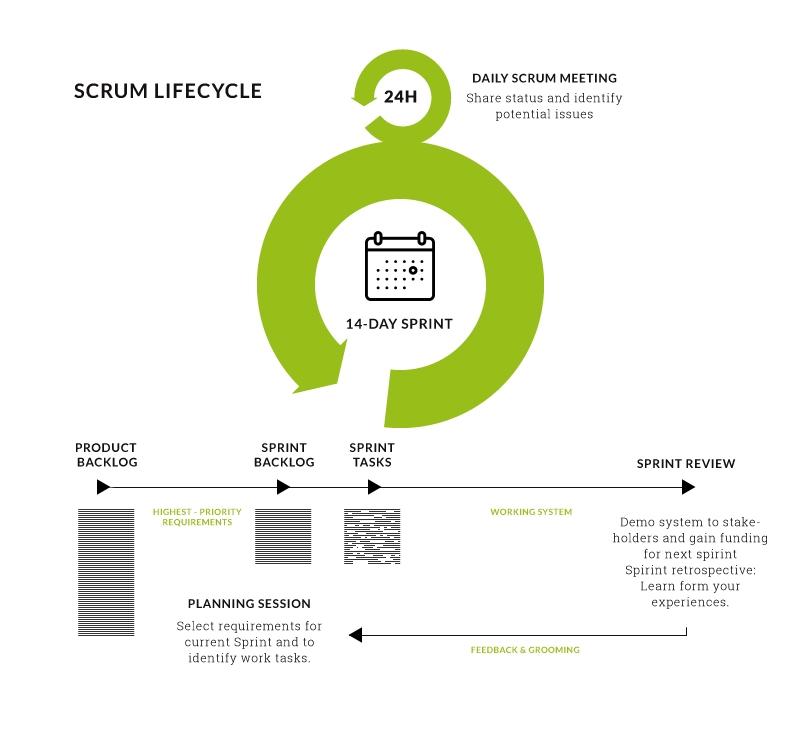
Each approach to software development has its own lifecycle. Unlike the traditional Waterfall methodology, the lifecycle of all Agile methods (including Scrum) is rather iterative than consecutive.
Scrum lifecycle is a number of consecutive steps and iterative stages that should be performed during the realization of any Scrum project. The iterative approach is the main principle of a Scrum lifecycle. The work on a Scrum project is subdivided into segments called sprints. The project develops from one sprint to another until the final product is ready. Each sprint is subdivided into several consecutive stages that it must pass from the beginning till the end.
THE SCRUM LIFECYCLE IN DETAIL
The first step of any Scrum project is the stage of gathering necessary information about the future product. It is the responsibility of the Product Owner. He is the person who contacts the customer to understand his vision of the future software. Gathering user stories is also one of his responsibilities. After all user stories are collected and all the customer’s wishes are considered, they are prioritized in a list that is called a product backlog. It is the main document of every Scrum project.
After the prioritization of the product backlog items, they are turned into tasks and divided into several sprints. The team makes it during the sprint planning meetings. The main goal of each meeting is to create a sprint backlog. It is a document that contains all tasks for a certain sprint. After the sprint is finished the work of the team will be estimated in accordance with the fulfillment of the sprint backlog requirements.
The next step in the Scrum lifecycle is the process of sprint execution. It includes a consequent performance of all sprint tasks and everyday evaluation of workflow. The progress of the sprint backlog requirements is evaluated during the daily Scrums – the team gatherings where all the positive and negative work issues are discussed.
After the sprint comes to its end, all members of the Scrum team participate in the sprint review and the sprint retrospectives. These gatherings help to find out what went wrong during the sprint.
The final step of every sprint is the stage of product estimation. The product is evaluated in accordance with the team’s definition of “Done” and provided to the customer to obtain his feedback. Then a new sprint starts, and the cycle repeats.